February 2026

I intend to track and share performance of the real time strategies I am trading. This will force me to be accountable and be business oriented.
No predictions, and no attempts at interpreting arbitrary chart patterns that may or may not come to fruition.
No attempts at drawing inferences from geopolitical developments or macro economic forecasts: I am too much of a simpleton to even try.
No patting myself on the back or suggesting that I called something in advance. There are enough folks out there doing a fine job of this already without my involvement.
Just real time results, good or bad.
My goal is to be a successful mechanical systems trader. Remove discretion. Remove emotion. Keep learning, and keep growing. Monitor and check system performance regularly against backtests. Try and be as objective as possible in interpreting results. The overall goal is to grow my equity curve: up and to the right, with acceptable drawdowns.
Ok, with this preamble behind me, here is where I stand as of February 28, 2026:
As at December 31, 2025, starting capital spread across different accounts was $368,441. This was spread amongst 9 different accounts, all with varying account sizes. I have outsourced approximately $720,000 to two independent asset managers so that capital is not included in the discretionary capital I am managing. There is also approximately $50,000 of additional capital not included in the starting capital above.
My goal for most of the second half of 2025 was to develop a number of long-only equity trend following systems based on my being inspired by reading Unholy Grails by Nick Radge. I ended up developing 4 Radge influenced systems that are now live, and 1 Cesar Alvarez influenced mean-reversion system that is now live. I’ve also developed 1 monthly rotation ETF system that is live, but no new signals yet. That system is being reserved for the $50,000 of additional capital once this system produces new signals.
Long-only equity trend following systems:
New Yearly High System, starting capital $30,000 (live February 2)
This system uses a simple set of rules:
9 slots
$RUI system, using an $RUI index regime filter: when $RUI is < 300 day SMA, system does not take new trades
Enter when price > 300 day SMA AND 100 day SMA > 225 day SMA AND 20 day relative ROC > $RUI ROC AND 30 Day HV < 35
Exit when price < 100 day SMA OR trailing stop hit
Bollinger Band Breakout System, starting capital $75,372 (live January 7)
This system uses a simple set of rules:
10 slots
$SPX system, using an $SPX index regime filter: when $SPX is < 300 day SMA, system does not take new trades
Using 150 day mid MA, enter when price > 2 Std Dev BB AND 75 day SMA > 175 day SMA AND 120 day ROC > 15% AND 20 Day HV < 35
Exit when price < 1.25 Std Dev BB OR trailing stop hit
Moving Avg Channel System, starting capital $20,000 (live January 23)
This system uses a simple set of rules:
10 slots
$RUI system, using an $RUI index regime filter: when $RUI is < 325 day SMA, system does not take new trades
Enter when price > 7 day MA channel AND price > 150 day SMA AND 20 day relative ROC > $RUI ROC AND 30 Day HV < 25
Exit when price < 4 day MA channel OR trailing stop hit
Trend Pilot System, starting capital $35,192 (live January 26)
This system uses a simple set of rules:
9 slots
$RUI system, using an $RUI index regime filter: when $RUI is < 75 day SMA, system does not take new trades
Enter when price > 150 day SMA AND 3 full bars above 150 day SMA AND 10 Day HV < 40
Exit when price < 75 day SMA AND 4 full bars below 75 day SMA OR trailing stop hit
SPX Mean Reversion System, starting capital $27,000 (live mid February )
I discussed this system in my last post. This was originally designed as an NDX system, but I evaluated that this system was over-optimized, with unacceptable drawdowns for my real time tolerance. I revamped this system in mid February.
In addition to the above systems, I subscribe to two external services that I have reserved for additional accounts, and I have mirrored one of my external managers in one of the last remaining accounts:
Price Action Lab Blog (Michael Harris), monthly HAA and DM signals. I have been following these signals for almost two years and I am very happy with the results. Approximately $107,000 of starting capital as of Dec 31, 2025. Link here: Price Action Lab
Quanta 72, weekly signals. I have been following these signals since late last fall. I am happy with the results. Approximately $23,000 of starting capital as of Dec 31, 2025. Link here: https://substack.com/@quanta72?utm_source=global-search
Starvine Capital: Steven Ko is just about one of the smartest long term investors I’ve had the pleasure of knowing. Steven is a good friend as well as a brilliant investor, and he manages approximately $300,000 of family savings. I have mirrored his approach in one of my accounts, approximately $40,000. The beautiful thing about Steven’s approach is there is hardly any trades and minimal turnover. Steven is a deep value investor who looks for diamonds in the rough. He has built up an impressive track record since 2015. If anyone is interested in researching Steven, here’s the link to his website: https://starvinecapital.com/
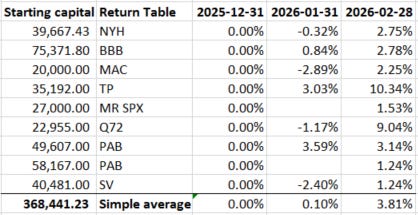
With all of this out of the way, here are the combined results since December 31, 2025 in return table format, with approximate starting capital by account, sorted by strategy:
Some overall comments and analysis:
NYH starting capital is $39,667 but above I noted $30,000. The discrepancy of $10K is 25% of capital in the same account that I have reserved for the monthly rotation strategy, which does not have any new signals yet.
PAB is traded in two accounts, but the larger account for $58,167 is a CAD only account, so it becomes expensive in terms of foreign exchange in buying USD ETF’s. PAB uses a trend managed futures ETF which I tried to replace with a similar US based ETF when I implemented the initial buys on Feb 2, 2026 in that account. The performance reflects adverse effect of foreign exchange in the CAD only account and the managed futures proxy underperformance vs. PAB
I am pleasantly surprised with the Trend Pilot performance in February. I don’t expect this to continue or be the norm. The system signaled a few very nice momentum trades that have just persisted in February: TPL, VRT and VNOM. I have no opinion on whether these names will persist into March or mean revert given their relative outperformance. Nor do I care: the system will signal the exits.
Q72 has performed really well in February as well. I am happy with the performance.
Until next time. Hoping the above is helpful to any readers in their own individual journeys.